Activity
Set the problem importance and parameters
This activity will help you set parameters around the 'problem space' so that you can maintain focus and understand what is urgent and what is important.
Once you’ve considered the ‘root causes’, you are ready to examine the nature, complexity and urgency of the problem at hand. You’ll be equipped with a wide range of useful information regarding the challenge, and better positioned to navigate possible explanations.
At this stage, it is important to set parameters around the ‘problem space’ so that you can avoid being distracted or overwhelmed by seemingly connected but ultimately unrelated matters, and to understand what is urgent and what is important from different perspectives.
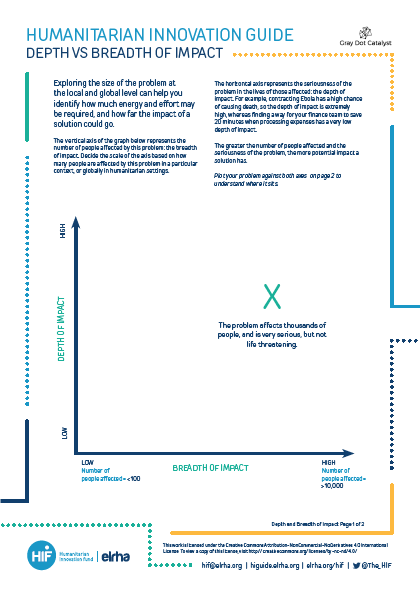
Humanitarian Parameters Box
Use each of the sections of the Humanitarian Parameters Box to explore where you are proposing to introduce the solution in relation to the:
- Humanitarian context
- Disaster management cycle
- Rules and regulations
- Crisis-affected community
- Problem holder
- Humanitarian architecture
When you work through each section, ask the additional question:
- What/who will need to make adaptations to their current way of doing things in order for this solution to work?
By doing this, you will geta good sense of how other organisations, people, structures or processes may need to adapt.
Urgent Vs Important
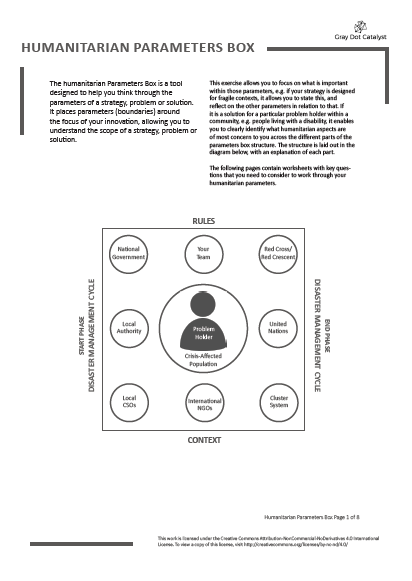
Exploring the differences between what is urgent and what is important to the affected community and your organisation can be an eye-opening experience. The Urgent vs Important exercise helps to work this out.
Download the template. First, map out where you feel the problem sits with regard to the two dimensions presented, from the perspective of crisis-affected populations. How urgent is the problem, for these communities? How important is it to them?
Next, map out another point, but from the perspective of your organisation. How urgent is the problem, for you/your organisation? How important is it to you/your organisation?
You might find that there is significant distance between these two points – some organisations do not prioritise urgency in responding to problems, even if they think they are important. If this is the case, you will want to think about how you can bring these two points closer together by making a case to your team, manager or other leadership.
This is the last sense-check you need to make before deciding whether it is worth moving on to the next section: the Challenge Brief. If you find that the gap cannot be bridged. Then you will probably need to ‘shelve’ this as a problem that your organisation should not work on. In this case, do not lose your good work. See if there are other organisations for whom there is a greater alignment of the problem and their strategy and work.
If there is sufficient alignment, you are now ready to move onto the next step.
Breadth and Depth of Impact
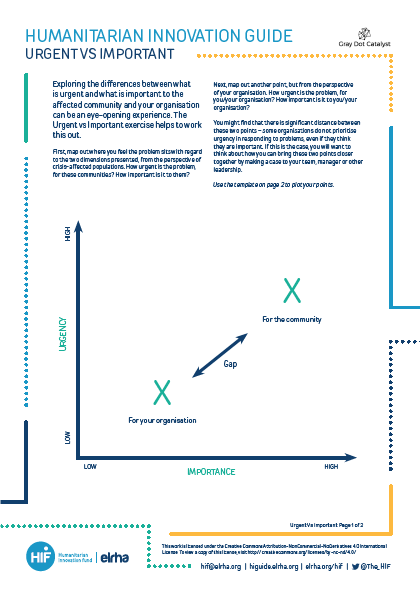
Exploring the size of the problem at the local and global level can help you identify how much energy and effort may be required, and how far the impact of a solution could go.
Download the template. The vertical axis of the graph represents the number of people affected by this problem: the breadth of impact. Decide the scale of the axis based on how many people are affected by this problem in a particular context, or globally in humanitarian settings.
The horizontal axis represents the seriousness of the problem in the lives of those affected: the depth of impact. For example, contracting Ebola has a high chance of causing death, so the depth of impact is extremely high, whereas finding a way for your finance team to save 20 minutes when processing expenses has a very low depth of impact.
The greater the number of people affected and the seriousness of the problem, the more potential impact a solution has.